Monday, 20 November 2017

Social Sciences. Unit 5. Spain in the Middle Ages. What was the Reconquista?

THE RECONQUISTA
When the Muslims created al-Andalus, many Christians moved to the mountains in the north. Here was where Visigoth noble Pelayo defeated the Muslims in Battle of Covadonga in 722 A.D. and the Reconquista began.

After that, Don Pelayo established the Kingdom of Asturias. Later on this kingdom became the Kingdom of León. There were other Christian kigdoms too, such as the Kingdoms of Castilla, Navarra and Aragón. 


Statue of Don Pelayo in Covadonga (Asturias)


From the 8th and the 15th centuries, the Christian kingdoms expanded in to the south. They conquered lands from al-Andalus. This process is called the Reconquista.

 
Christians wanted to conquer al-Andalus for three reasons:

  1. The Christian kings needed more land for growing crops, raising animals and because the population was increasing.
  2. The Christians kings thought the lands of al-Andalus should be ruled by Christians, as in the times of the Christians Visigoths.
  3. After al-Andalus was divided into small taifa kingdoms, it was easier to conquer them.

During this time, despite the fights for the Reconquista, Muslims, Christians and Jews lived together and established a rich excange between cultures.


Alfonso VI was King of Castilla and León. In 1085 he conquered Toledo from the Muslims. It was a very important victory for the Christian armies because Toledo was a strategic area and a symbol of Christianity from the time of Visigoths.


Statue of Alfonso VI. Jardines de Sabatini, Madrid.


Alfonso VI conquered Toledo, 25th may 1085. Banco de la Plaza de España de Sevilla


 In 1212 the Christians won the Battle of Navas de Tolosa in Jaén.


Battle of Navas de Tolosa (Jaén) 1212. This picture is found in the Palacio del Senado (Madrid)


Jaime I was King of Aragón. He conquered the Balearic Islands from the Muslims in 1229 and parts of Valencia in 1224.

El Llibre del Fets. Autobiographical chronicles of James I The Conqueror.


Fernado III was King of Castilla y León. He conquered Córdoba in 1236 and Sevilla in 1248. 
Fernando III, King of Castilla and León.


Granada was the last Muslim Kingdom in the Iberian Peninsula. In 1492 king Fernando II of Aragón and Isabel I of Castilla, known as the Catholic Monarchs, conquered Granada. The Christian Reconquest was completed.

In the following picture we can see King Boabdil surrenders the Kingdom of Granada to the Catholic Monarchs.

La Rendición de Granada by F. Pradilla (1882). This picture is found in the Palacio del Senado (Madrid).
 
Click on the image below and you'll know the main characters of the Fall of Granada.

http://www.juntadeandalucia.es/averroes/centros-tic/41009470/helvia/aula/archivos/repositorio/0/191/html/recursos/la/U15/pages/recursos/143175_P201.html

 
Here you have a famous Spanish TV serie where you can see this important event in the History of Spain.


FALL OF GRANADA (1492) The last taifa kingdom (Granada, Málaga and Almería)


The Muslims conquered most of the Iberian Peninsula from the Visigoths in only few years. But it took the Christians nearly 800 years to reconquer the peninsula from the Muslims!


EXERCISE. Write true or false. If it is false, write the right sentence.


1. It took about 100 years for the Christian kings to conquer al-Andalus.


2. The Christian kingdoms were expanding because they needed more land. 

3. King Jaime I of Aragón conquered Granada in 1492. 


4. In 1212 The Muslims won an important battle against the Christians. 
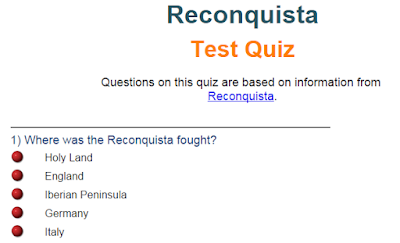

5. The Kingdom of Granada was the last Muslim kingdom to be conquered. 


http://www.ducksters.com/history/middle_ages/reconquista_questions.php

Social Sciences.Unit 5. What was life like in the Chrisitian kingdoms? (2nd part)


THE REBIRTH OF THE CITIES


In the 13th century, at the end of the Middle Ages, wars were not as frequent as before. As a consequence, population of the Christian Kingdoms grew and cities developed. This led to a new type of society in which trade (commerce) became an important activity. For this reason a new social class appeared: the bourgeoisie (burguesía) or middle class.


Medieval cities were surrounded by walls for their protection.


The market was the centre of the city's economic activity. Artisans and merchants doing the same kind of work formed groups called guilds (gremios). For example: the baker's guild, the carpenter's guild, painter's guild etc. Each guild had its own street and controlled the quality and price of their products. 

In Madrid you can find a very famous street next to the Plaza Mayor which belonged to a guild: La Calle de Cuchilleros.


Cities had cathedrals. They were a symbol of prosperity. One example is the Burgos Cathedral. 


EXERCISES


1. Why did middle class appear at the end of the Middle Ages?
2. What were guilds? Why were they important? 
3. Why did cities have cathedrals? 


4. Write true or false. If it is false, write the right sentence.


4.1. In the 13th century, wars were very frequent. 
4.2. In the 13th century, population of the Christian kingdoms grew and cities didn't develop.
4.3. In the 13th century, a new social class appeared, the peasants.
4.4. Guilds controlled colour and size of their products. 


http://www.primaria.librosvivos.net/archivosCMS/3/3/16/usuarios/103294/9/5EP_Cono_in_ud14_Medieval_1/frame_prim.swf

Tuesday, 14 November 2017

Unit 2. Classification of living things. Monera, Fungi and Protista kingdoms. Viruses.

THE FUNGI KINGDOM

Wild mushrooms are living things that grow on forest floors, tree trunks and even on top of each other. They need moist, cool temperatures and some light. Here it is one mushroom you can find in one of the trees of our school, amazing!! isn't it?


Which living thing can you see?
Which kingdom does it belong to?
Is this living thing unicellular or multicellular?


THE PROTISTA KINGDOM


Protists include two very different types of organisms: algae and protozoa.

ALGAE
Algae are aquatic living things that can be unicellular or multicellular. They can make their own food (autotrophs). Somo multicellular marine algae can grow to a very large size.


Algae are very nutritious, so they are used as food in many countries. They are also used as fertilizer and to produce cosmetics.


PROTOZOA

Protozoa are unicellular living things that live in aquatic environments. They feed on other organisms. Somo protozoa can cause diseases, like malaria.


THE MONERAN KINGDOM

Monerans are unicellular living things. This kingdom includes bacteria, the most abundant of all living things.

BACTERIA

Bacteria are the smallest and simplest living things, and can only be seen through a microscope.

Most bacteria feed on other organisms, but some bacteria make their own food.

Bacteria can be foound everywhere in the world. They can live in all kinds of evnironments: in water, soil, air or inside other living things.

Some bacteria are helpful, like the ones used to make yoghurt, but other are harmful, like the ones that cuase cholera.


VIRUSES

Viruses are not included in any of the five kingdoms because they are not considered living things. They cannot perform vital functions (nutrition, interaction, reproduction) on their own. A virus is not a cell. It is a microscopic body that can only reproduce inside living things. Viruses may cause illnesses (influenza gripe, measles sarampión, chicken pox varicela etc.)


Unit 2. The classification of living things. Vertebrates.

http://www.sheppardsoftware.com/content/animals/kidscorner/games/animalclassgame.htm


A PLATYPUS


Unit 2. Natural Sciences. Living Things.


http://www.juntadeandalucia.es/averroes/centros-tic/04006446/moodle2/pluginfile.php/27/mod_resource/content/1/index.html